Svitle
Grey BeesSvitle is a nearby village whose contrasts with Little Starhorodivka give Sergeyich a rare route to food, human company, and mutual kindness. Three kilometres away, it is close enough for a journey on foot yet distinct in its electricity, residents, and supplies; the road connecting the villages passes through a landscape shaped by military positions and the risk of unexploded shells.
Setting and wartime conditions
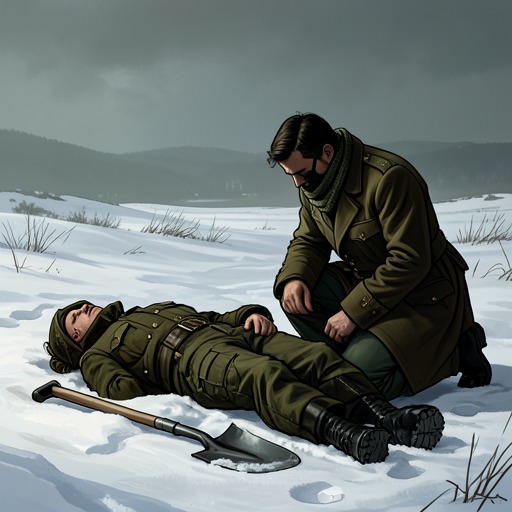
From the edge of his garden, Sergeyich can look across a snow-covered field toward Zhdanivka, where Ukrainian troops have hidden fortifications. A dirt road runs past a line of trees toward the village, but no one has driven it since the conflict began. Before the spring of 2014, the same road led onward to Svitle and Kalynivka. The blocked route registers how war has altered not only travel but the familiar scale of the neighboring countryside.
Despite its proximity, Svitle is not simply a safe refuge. Sergeyich remembers that an elderly resident there blew himself up while working in his garden, where an unexploded shell had become concealed in the earth. People in Svitle nevertheless keep planting. Sergeyich has stopped planting in his own garden for fear of buried shells, but the possibility of living elsewhere does not dislodge his conviction that home is where he must return. Svitle thus represents both access to needed provisions and the persistence of danger within everyday rural life.
A journey for food and company
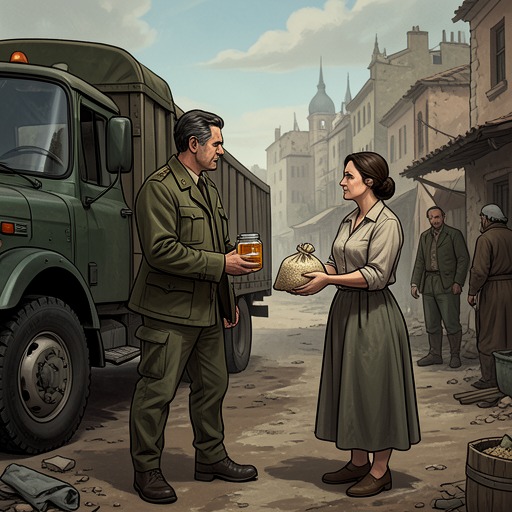
During a power outage, Sergeyich imagines the ordinary comforts electricity would restore: television before bed, cooked noodles in the refrigerator, and eggs fried in a pan. The thought of eggs becomes a practical reason to leave. Svitle is only three kilometres away, and he knows people there, including Nastasya, whose yard has chickens and other animals. He sets out after dark with two litres of honey to exchange for eggs, following a road he understands as smooth, straight, and sheltered from the Ukrainian positions and Karuselino.
The trip also breaks the isolation of his home village. When Svitle’s lights come into view, Sergeyich feels joy alongside envy. On entering its principal street, he is relieved that the remaining task is simply to reach Nastasya’s house at the far end. He is glad to hear dogs barking: in Little Starhorodivka, only he and Pashka remain, and the dogs and cats have disappeared. The sound of animal life in the neighboring village makes its inhabited streets a contrast to the emptiness he has left behind.
Exchanges and hospitality
Sergeyich’s visits to Svitle are structured by reciprocal gifts rather than by money alone. He offers honey to obtain food, but the exchanges repeatedly exceed a simple trade. After he visits Nastasya, he returns because he has forgotten sweets for children who had been at her house. He carries the sweets to their home himself, identifying himself as Sergeyich from Little Starhorodivka and explaining that he has brought a gift.
The children’s mother responds with a substantial return gift: she runs out to the yard and comes back with his backpack full, warning him that it contains a three-litre jar of lard. Sergeyich is amazed by the kindness of someone he had not known. Svitle therefore becomes a place where a small, intentional offering can open into unexpected care, particularly significant against the scarcity and social abandonment of his own village.
The same pattern of exchange continues in practical dealings. During a mail delivery, Sergeyich directs the driver’s companion toward Svitle, giving him a route through the village: straight ahead, then left at the end of the street, right at the bombed-out church, and straight on. On another occasion, Sergeyich offers honey to Petro, who declines to take it away but accepts some to have with his tea. Later, while moving his hives with Galya, Sergeyich brings out two one-litre jars, specifying that together they weigh exactly three kilograms, and asks whether she might sell some. She proposes paying for the honey in groceries instead. Across these encounters, honey functions as both food and a means of negotiating reciprocal support.
Connections across the conflict
Svitle is connected to Little Starhorodivka by the routines and relationships that survive disrupted infrastructure. It is a destination Sergeyich has not visited since the previous autumn, yet he still knows people there and can reach Nastasya by following a road sheltered from military positions. The route makes neighboring villages close in distance but not interchangeable: one is nearly empty and without electricity, while the other’s lit streets and domestic provisions offer a temporary return to ordinary social life.
That connection also runs through war’s damage. The mail driver’s directions use a bombed-out church as a landmark, and the risk of buried shells in Svitle’s gardens complicates any simple opposition between a dangerous home and a safe neighboring settlement. When Sergeyich later explains that he took candles from the bombed church in his own village and brought them to Aisylu, his account further links the damage and acts of care that reach between communities. Svitle’s place in the narrative is therefore neither an escape from wartime conditions nor merely a stop for supplies: it is a lived neighboring world where need, danger, and generosity meet.